

Houston’s market average is context for a sale, not a promise of when your money will arrive. If you need to sell a house in Harris County or Fort Bend County, build a timeline around your property and the work remaining before closing.
HAR released its September 2026 Housing Market Update on October 14, 2026. For Greater Houston single-family properties recorded in its MLS, it reported:
| Measure | September 2025 | September 2026 |
|---|---|---|
| Average days to sell | 56 days | 58 days |
| Months of inventory | 5.1 months | 5.5 months |
| Median sale price | $325,990 | $325,000 |
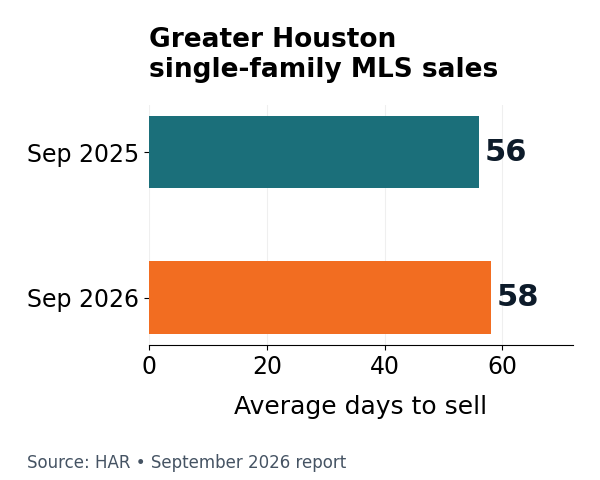
Source: HAR’s September 2026 report, accessed October 14. This is a regional MLS measure, not a Harris County-only figure, Fort Bend-only figure, cash-buyer deadline, or valuation of your particular house.
The selling average increased by two days. That modest difference does not support a sweeping claim that every property is hard to sell—or that an as-is cash sale is always the better financial choice.
Ask what the timeline actually includes
When someone says a house can sell in a certain number of days, ask where that clock starts and stops. Are they describing marketing time, time after accepting a contract, or a proposed date for completed closing and funding?
A useful plan names the milestones:
- The property is ready for its chosen sale route.
- There is an acceptable written purchase agreement.
- The parties have satisfied the agreement’s remaining requirements.
- Closing and funding are completed.
These are planning questions, not a formula for adding days to HAR’s figure. Do not take the regional average, tack on an arbitrary closing period, and call the result your property’s forecast.
For a direct purchase, our Houston cash-sale timeline guide explains why the actual property and closing requirements matter. Ask the same milestone questions of any buyer.
Replace a deadline guess with three planning scenarios
Pick a shorter, middle and longer duration you could reasonably consider. Then test what each would require from you. A house needing a major repair decision, an occupied rental and a vacant inherited property may create very different practical workloads.
Consider:
- Which expenses would you keep paying?
- Would you need to prepare the house or coordinate access?
- Could you manage a changed closing date?
- Does the plan depend on a sale price that has not been offered?
- What information would make the estimate more reliable?
Keep your comfortable deadline separate from a buyer’s documented ability to meet it. A desired date is useful for negotiation; it is not evidence that all transaction steps can finish by then.
An original carrying-cost illustration
These are hypothetical planning numbers, not Houston market costs or an offer. Assume your selected continuing expenses total $45 per day. Using simple multiplication:
| Assumed duration | Calculation | Illustrative expense |
|---|---|---|
| 30 days | 30 × $45 | $1,350 |
| 60 days | 60 × $45 | $2,700 |
| 90 days | 90 × $45 | $4,050 |
The point is sensitivity, not a prediction: a longer sale creates more of whatever continuing expense you actually have. Replace $45 with your own figures and avoid counting the same expense twice in a seller-net estimate. This example is an expense budget, not a tax or accounting calculation; mortgage principal and other items can require different treatment in a complete financial comparison.
Use our net comparison guide to organize the rest of the transaction. A higher sale price may still justify a longer process. A shorter process may be worth accepting a different price. Work through both possibilities instead of assuming the headline offer settles the decision.
Make the choice around your property
Listing can fit an owner who has the capacity to prepare, market and coordinate the house and wants to pursue a retail buyer. Ask for property-specific comparable sales and a plan, rather than using a metro-wide median as your asking price.
A direct CashAsIs purchase may fit an owner who wants the property evaluated in its current condition and prefers to avoid a retail make-ready or public buyer-search process. Our offer still has to work for the property, and legitimate closing requirements remain.
Cash does not mean every step disappears. The practical question is which work, costs and uncertainties remain under each actual proposal? Our as-is versus listing guide provides a broader process comparison.
Request an offer you can compare
Tell CashAsIs about the address, condition, occupancy and timing you have in mind. We can review whether a direct purchase fits and discuss an offer when it does.
You can then put that real proposal beside a realistic listing plan. Check expected proceeds, required work and remaining milestones before deciding. The current market report helps frame the conversation; your property’s facts should drive the choice.